
 Leo Gbolagade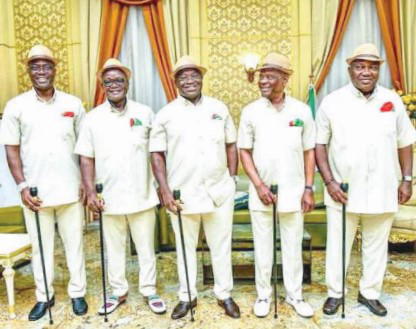
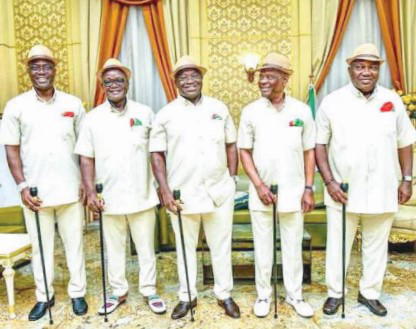
Just when Nigerians thought the Asoebi saga had ended with mismatched kaftans and silent WhatsApp exits, two former members have decided the story needs a sequel and they brought it back with sharper edges. Nyesom Wike and Seyi Makinde are no longer former allies managing distance. They are rival power centres moving toward collision.

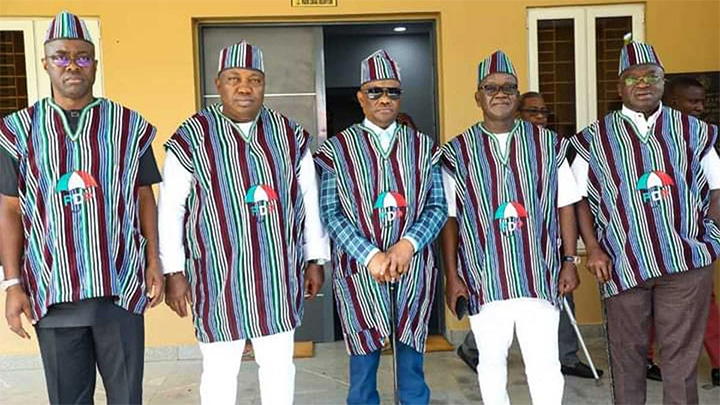
The Asoebi Boys were meant to be a chapter. Five governors bound by shared grievance, dressed in coordinated defiance, shaking the foundations of the Peoples Democratic Party with theatrical unity. They moved as one. Spoke as one. Threatened as one. Their rebellion was choreographed, almost ceremonial.
But alliances built on convergence rarely survive the disappearance of the common enemy. Today, two of those former groomsmen stand on opposite ends of the same political estate.
Not disagreement. Not tension. Contest.
When Wike declared himself “001 of Abuja and Port Harcourt,” it was not a nickname. It was hierarchy spoken aloud. In Nigeria’s political dialect, 001 signals proximity to executive power, access to machinery, influence over levers that do not appear on campaign posters. It was a reminder that authority is not always electoral. Sometimes it is structural.
Then came the warning that he could enter Oyo State and scatter party structure. That sentence was not geography. It was a signal.
In Nigerian politics, structure is oxygen. It determines delegates. Delegates determine primaries. Primaries determine candidacy. And candidacy determines who gets to write the future. To threaten structure is to threaten survival. Makinde responded with a single word that landed heavier than a paragraph: vagabonds. In our political culture, that word does not float lightly. It suggests disorder, indiscipline, illegitimacy. He did not attach a name. He did not need to. The audience understood.
With that exchange, nostalgia ended. What we are witnessing is not leftover bitterness from 2023. It is succession anxiety surfacing early. The G5 were formidable when united against a grievance. They became vulnerable when ambition no longer required coordination.
History offers precedent. Obasanjo and Atiku once governed in tandem, until overlapping power turned partnership into rivalry. Unity fractured not because affection vanished, but because future control was at stake. Structure became weapon. Loyalty became negotiable.
The present standoff echoes that logic. Wike operates from federal altitude, armed with ministerial authority and access to the centre. Makinde operates from consolidated regional stability, a second term granting him time and internal influence. One projects force. The other projects order.
Neither is improvising. Every public statement is choreography. Every insult is calibration. Governors, financiers, and presidential hopefuls are not watching for drama. They are calculating alignment.
Former allies are dangerous opponents because they understand each other’s architecture. They know where the beams are weak. They remember the private strategy sessions. They anticipate the countermove before it is deployed. But beneath the chessboard lies something more unsettling.
This rivalry is not simply about two men. It is about a political culture where ideology is thin, but positioning is thick. Where parties are less philosophical homes and more strategic vehicles. Where unity often performs well in photographs and fractures quietly in private. The Aseobi Boys were never bound by doctrine. They were bound by timing.
Once timing expired, ambition stepped forward. And ambition, unlike fabric, does not fade with ceremony. The deeper tension is not who insulted whom. It is who controls the gate when 2027 approaches. Who defines legitimacy. Who anoints structure. Who becomes indispensable to the centre of power.
Because in Nigeria, power rarely disappears. It relocates.And when two actors both believe they are central to its movement, the system does not soothe the conflict. It tests capacity. The tragedy is not that allies fall out. That is politics. The tragedy is that the electorate often remains a spectator to elite rivalry. While structures are defended and positions secured, ideology stays negotiable. The language is fierce. The stakes for ordinary citizens remain uncertain.
The matching kaftans are gone. The coordinated rebellion is memory. What remains is instinct. And instinct, when stripped of costume, reveals what alliances were truly made of.
In the end, this may resolve in consolidation. Or collapse. But it reveals something older than the G5 and larger than the PDP. In Nigerian politics, unity is frequently strategic. Loyalty is conditional. Structure is sacred. And ambition is patient. When ambition finally speaks without costume, it does not whisper.
It declares. And what it declares is not brotherhood. It declares battle.
The post AsoEbi Boys: A war beyond words, by Stephanie Shaakaa appeared first on Vanguard News.

 Miles Ibunkunolu
 David Benjamin



%20to%20the%20rescue?)